


Article: Microblading Room Setup: The Environment That Makes Clients Say Yes to the Price
Microblading Room Setup: The Environment That Makes Clients Say Yes to the Price
Microblading is premium work. The pigment is permanent for one to three years. The precision is millimeter-level. The trust a client places in you is significant — they are choosing what their face looks like every day for the foreseeable future.
Premium work requires a premium environment. Not because of aesthetics alone, but because the environment is part of how clients make the decision to trust you with that level of work at that price point.
Here is how to set up a microblading room that makes the price feel obvious rather than steep.
Why The Room Is Part Of The Pricing Argument
Microblading artists charging $150 for their work and microblading artists charging $600 for their work are often equally skilled. The portfolio quality might be comparable. The technique might be identical. The difference in what they can charge is partly market, partly experience level — and substantially the environment they work in.
A client who walks into a carefully designed, well-equipped studio has a different trust experience than a client who walks into a room that looks improvised. Before you have demonstrated anything, before you have shown a single healed result, the room is communicating whether you are someone worth paying for.
A room that looks intentional, controlled, and professional builds trust before you say a word. That trust is the foundation of premium pricing.
The Anchor: Your Treatment Bed
In a microblading room, the treatment bed is the central piece of furniture. It is in every photo of your space. Your client lies on it for one to three hours during a full brow session. It is the first thing clients see when they walk in and the last thing they interact with when they leave.
Most microblading artists are working on one of three bed types: a massage table with additions, an imported spa bed, or a purpose-built ergonomic bed. Here is the honest comparison.
A massage table is not designed for microblading work. The leg placement was built for therapists standing alongside the table — not for artists sitting at the head, working close to the brow area for hours. You fight the furniture to maintain the right position, which affects your precision over time and strains your body in the process. The sheets and bolsters create a setup that generates constant laundry and never photographs cleanly.
An imported spa bed in the $2,500 to $4,000 range sounds like a professional solution. But a significant portion of that price goes to ocean freight, warehousing, and supply chain overhead — not the product itself. The bed is a fraction of what you spent. That shows in construction quality over time.
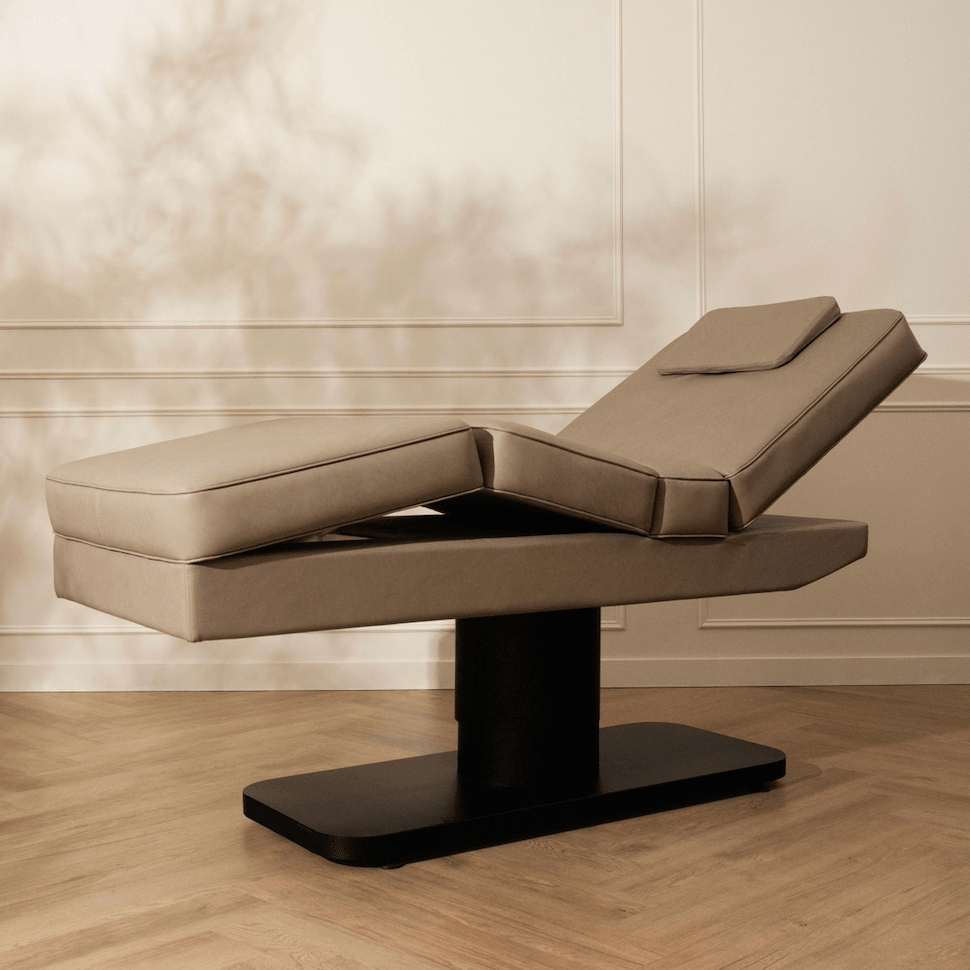
A Plush + Oak bed — the Edda Cloud, the Brynn, or the Vera — is built specifically for artists doing close precision work at the head of the bed. The open leg clearance lets you sit in the position you actually work in. The anti-gravity ergonomic curve cradels the client naturally — which matters more than most microblading artists realize. A client who is genuinely comfortable during a two to three hour session holds still. A client who is uncomfortable subtly shifts. That movement affects pigment placement.
Under the foam is a full tensile webbed suspension system — not plywood. The foam sits on woven tensile webbing that flexes and breathes. The client is suspended rather than compressed against a hard base. It feels like quality furniture because it is built like quality furniture. Clients ask what they are lying on. That question is part of the premium experience.
Every Plush + Oak bed is made to order. You choose the color from a full range — not three stock options. The bed becomes part of your studio's brand identity, not a generic piece of equipment that could be in anyone's room.
Designing A Microblading Room For Premium Positioning
The room that justifies $400 to $600 brow work communicates both clinical precision and beautiful professionalism. Too clinical and it feels cold. Too decorative and it does not communicate the procedural seriousness that microblading requires. The balance is intentional: a room where every element was chosen with purpose.
Palette And Atmosphere
Deep, controlled wall colors — navy, forest green, or soft charcoal — against clean trim convey seriousness and luxury simultaneously. If you prefer light, warm off-whites and sandy taupes with textured walls achieve a soft editorial quality that reads as elevated without being clinical.
Avoid the purely decorative spa aesthetic for a microblading studio. Clients making a multi-year commitment to their face want to feel that the artist they chose is precise and professional. The room should reflect those qualities.
Lighting
Lighting in a microblading room has two purposes. For your work: you need true-color, daylight-balanced lighting with dedicated task illumination. Shadows are unacceptable in precision work. For the client's experience: ambient lighting should be warmer and more controlled. A client who walks into a room lit like a clinical laboratory feels examined, not cared for.
Invest in a quality task light for your working position and manage ambient lighting separately.
Organization And Tools
Visible organization — a clean tray setup, labeled storage, orderly tools — tells clients you run a controlled, methodical operation before you demonstrate it on their brows. In microblading, where the client is trusting you with permanent work, visible competence is reassuring.
The Consultation Experience
Where and how you consult with clients before the procedure is part of the premium experience. The conversation about face shape, arch design, pigment color — that conversation in a beautifully designed, professional environment builds different trust than the same conversation in a cluttered room with a folding table.
Every element of the consultation area — the seating, the lighting, the mirror, the overall atmosphere — is doing work before the needle touches skin.
The Business Case
More than 87% of Plush + Oak customers reported that their upgrade helped attract more clients. Over 93% saw revenue increase after upgrading their furniture. For microblading artists specifically, the pricing differential between a studio that communicates premium and one that does not can be hundreds of dollars per appointment.
A $3,000 bed investment that allows you to charge $500 instead of $200 per session pays for itself in a matter of weeks at normal booking rates. That is the math on what environment does to perceived value.
Your skill produces the result. Your room produces the trust that makes the result worth paying for.
Visit plushandoak.com to find the Edda Cloud, the Brynn, and the Vera collection — and to configure the bed that anchors your microblading studio with the presence it deserves.
Ready to choose the treatment bed that anchors your Microblading studio? Explore our PMU bed collection →