


Do You Have Shrimp Back? A Posture Check for Salon Pros
Shrimp Back: The Posture Problem Every Lash Artist and Esthetician Should Know
A posture check, a fix, and the honest answer about what's actually causing it.
"Shrimp back" — the forward-curling posture popularized on TikTok — is showing up in lash artists, estheticians, and salon pros at alarming rates. Here's how to spot it, fix it, and stop it.
If you've been on the internet at all this year, you've seen the term.
Shrimp back.
The shoulders curl forward. The upper back rounds. The head juts ahead of the spine. From the side, the silhouette looks — well — like a shrimp.
It started as a TikTok joke. It's not a joke. And nowhere is it more common than in salon work.
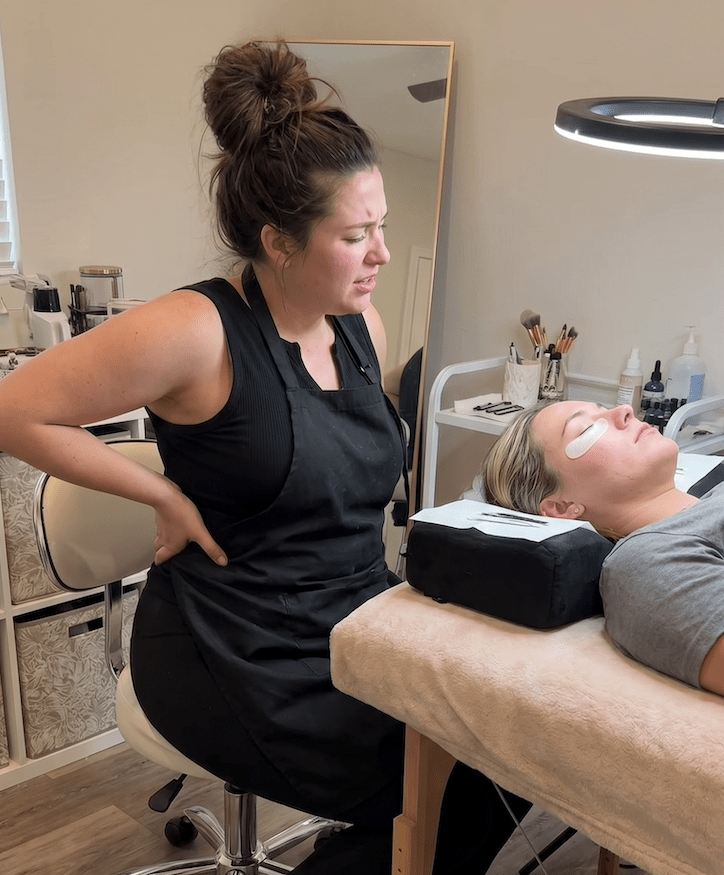
Lash artists. Estheticians. Brow techs. Nail artists. Massage therapists. Anyone whose job involves leaning over a client for hours at a time is a candidate. And most of you already have it, in some form, whether you know it or not.
Let's do the posture check. Then let's talk about why it happens. Then let's actually fix it.
The 30-second posture check
Stand sideways in front of a mirror. Or better — have someone take a photo of you from the side, in your normal standing posture. Don't pose.
Draw an invisible vertical line from the floor up through your ankle.
In a neutral posture, that line should pass through:
- Your ankle
- The middle of your knee
- The middle of your hip
- The middle of your shoulder
- The middle of your ear
Now look at where things actually sit.
- Are your shoulders forward of your hips? That's the first marker.
- Is your head forward of your shoulders? That's the second.
- Is there a rounded curve at the top of your spine where your neck meets your shoulders? That's the third.
Three for three? You've got shrimp back.
Two for three? You're on your way.
Even one for three matters. The body doesn't suddenly slip into a bad pattern. It drifts.
Why salon pros are uniquely at risk
The way we work is the way we shape.
Every appointment requires you to lean forward. Every detail requires you to lean closer. Lashes are millimeters from the eye. Skincare is at the level of the pore. Brow shaping happens at the precision of a single hair.
You can't do this work and keep a perfectly stacked spine. The work itself pulls you into the shape.
But here's the part most people miss:
The shape isn't the problem. The duration is.
A lash artist holds the forward-leaning posture for 90, 120, 180 minutes at a stretch. Six to ten times a day. Five to six days a week. Thousands of hours a year.
The muscles that hold the chest open get long and weak. The muscles that pull the shoulders forward get short and tight. The neck extends to keep the eyes on the work. The body adapts to the most-held position — and slowly, that position becomes your default.
That's shrimp back. That's how it forms.
What it actually does to your career
This isn't a vanity issue.
Forward head posture adds load to the cervical spine. Every inch your head sits forward of your shoulders increases the effective weight on your neck by roughly ten pounds. A two-inch forward head is asking your neck to support thirty-plus pounds, all day, every day.
The downstream effects:
- Chronic tension headaches
- Pinched nerves in the neck and shoulders
- Reduced lung capacity (a rounded chest cavity literally shrinks the space your lungs have to expand)
- TMJ tension
- Tingling and weakness in the hands
- Mid-back pain that no amount of stretching seems to resolve
- A visibly aged silhouette in your 30s that looks like someone twice your age
It also affects how you look in your own content. If you're filming yourself working, posing for press shots, or shooting reels for marketing — shrimp back is doing you no favors on camera.
How to fix it
Shrimp back is reversible. The earlier you address it, the easier it unwinds. Here's the order of operations.
1. Open the front
The muscles that need lengthening are the chest, the front of the shoulders, and the hip flexors. Tightness in any of these pulls the upper body forward.
- Doorway pec stretch. Forearm against a doorframe, elbow at 90 degrees. Step forward gently. Hold 30 seconds per side. Two to three times a day.
- Couch stretch / kneeling hip flexor stretch. One knee down, back foot elevated. Squeeze the glute. Hold for a minute per side.
2. Wake up the back
The muscles that need strengthening are the mid-back, the rear shoulders, and the deep neck flexors.
- Wall angels. Stand with your back flat against a wall. Arms up like a goal post. Slide them up and down without losing wall contact. Twenty reps.
- Chin tucks. Sit tall. Pull your chin straight back (not down) like you're making a double chin on purpose. Hold five seconds. Ten reps.
- Band pull-aparts. A resistance band, arms straight, pull apart at chest height. Twenty reps, two to three times a day.
3. Move every 30 minutes
The longer you hold any posture, the harder it is to leave it. Set a timer. Between clients, do not sit and scroll. Stand up. Roll your shoulders back. Reach overhead. Reset your spine.
4. Fix the upstream cause
Stretching alone won't undo eight hours of bad posture per day. You're stretching for ten minutes and reinforcing the bad shape for ten hours.
The math doesn't work.
The real fix is the workspace itself. Specifically:
- Your bed's height must let your elbows rest at or just below 90 degrees while you work. Most beds force you to hunch. Most stools force you to compensate.
- Your bed's leg space must let you sit close enough that you don't need to lean forward to reach the client. Beds with no leg cavity make shrimp back almost guaranteed.
- Your client's comfort matters more than you think. A client who can't relax keeps moving — and you lean closer to keep your work precise. Their unrest becomes your strain.
When the working surface is shaped correctly, you don't have to hunch. You can do detail work at full spinal length. Your body stops adapting to a compromised shape because it never has to enter one in the first place.
The honest answer
You can stretch every day, foam roll every night, and book a monthly massage — and still have shrimp back at the end of the year — if your workspace is forcing you back into the shape for ten hours a day.
Fixing the body without fixing the setup is a treadmill.
Fixing the setup is how artists work for twenty years without their bodies giving out.
What a workspace built for posture actually looks like
It looks like this:
- A bed shaped to bring the client to you — not the other way around.
- Leg space designed for the artist, not for the catalog photo.
- A working height that fits your body, not a generic average.
- A surface that allows the client to fully release, so you don't have to lean in and grip harder to compensate.
- No need for toppers, bolsters, rolled towels, or accessories. The foundation does its job.
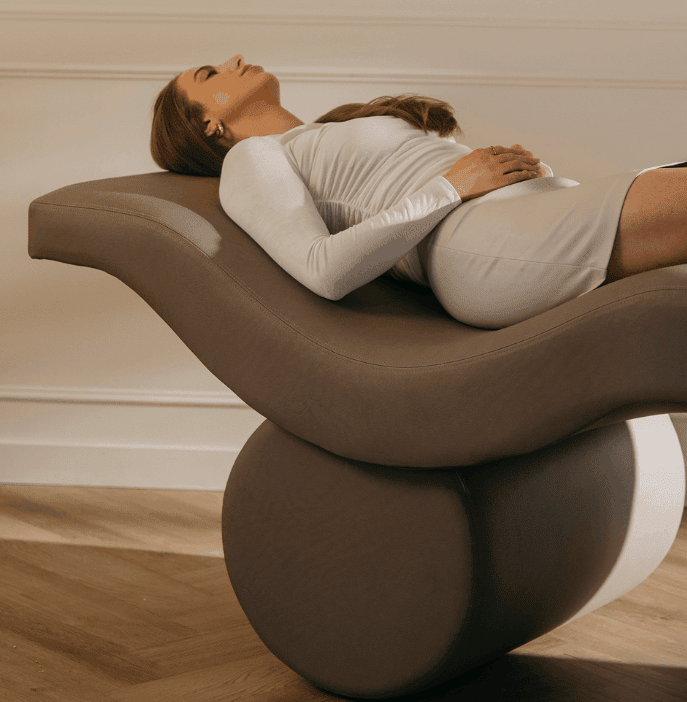
That's what we build. Sculpted, not assembled. Designed for the body of the artist and the comfort of the client — at the same time, without compromise.
The future of salon furniture isn't more support pillows.
It's a foundation that doesn't need them.
Aesthetic. Functional. Made to order.
From us, to you.
Explore the Plush + Oak Collection →
Related reading:

Written by Courtney Buhler